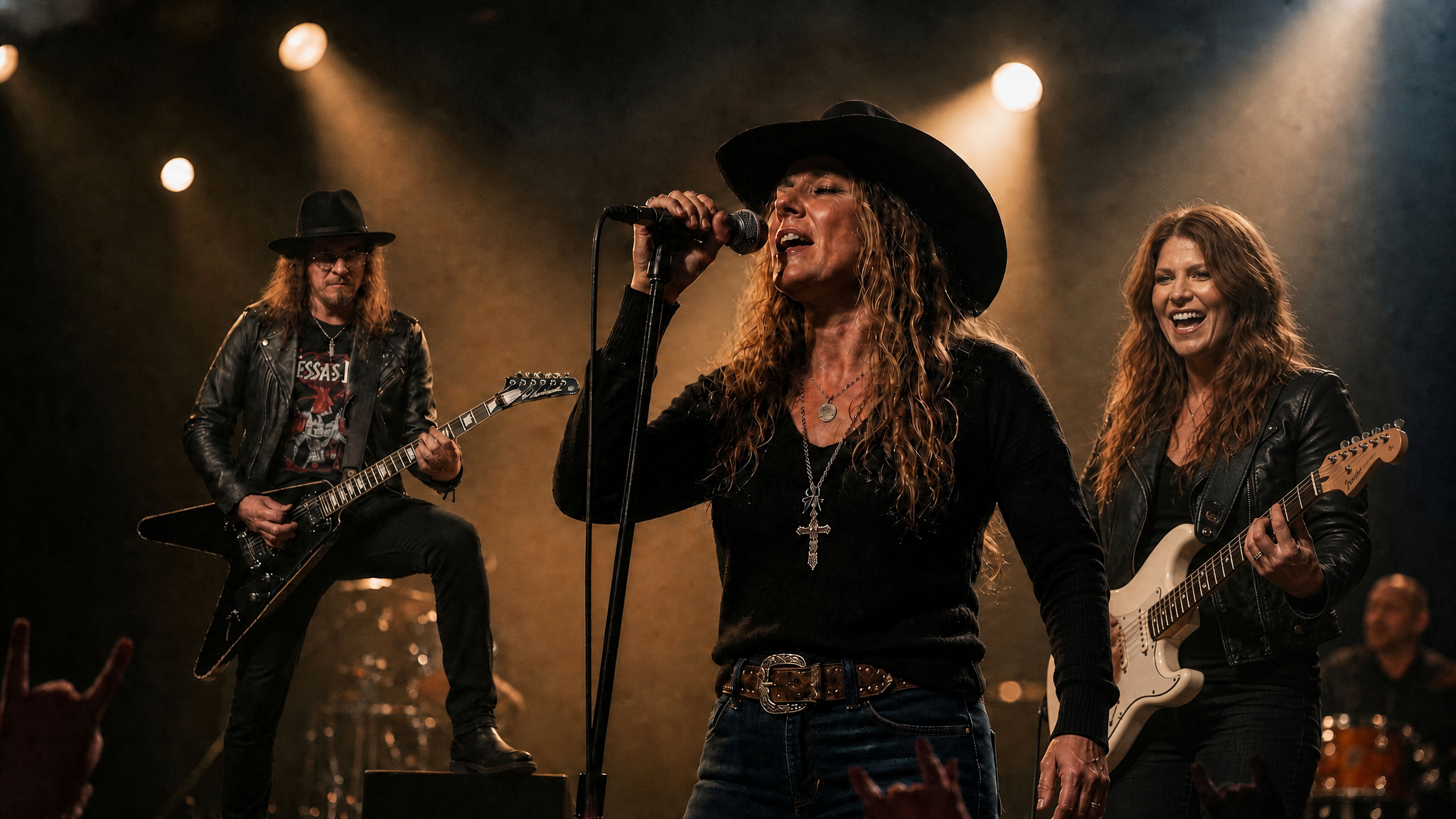
If you drive far enough down a winding two-lane road just outside Hope, Arkansas, past the cotton fields and the old gas station that hasn't sold a gallon of anything since 1997, you'll eventually hear it — the rhythmic clang of wrenches, the pneumatic hiss of air tools, and the low, guttural hum of diesel engines being coaxed back to life. That's the sound of Hadleigh Mae's shop. And if you're lucky, and the bay doors are open, you might also hear her singing.
Hadleigh Mae is a lot of things to a lot of people. To 25 employees and their families, she's the woman who kept the lights on when everything was going dark. To the farmers, truckers, and heavy-equipment operators across Hempstead County and the surrounding region, she's the voice on the other end of the phone at 2:00 a.m. when a combine is broken down in the middle of harvest and the whole season is on the line. To the fans of Tessa's Lair, she's the drummer, the co-vocalist, the dual frontwoman who with Tessa and delivers performances that leave audiences haunted and hungry for more.
But before any of that — before the stages, the songs, the crowds — Hadleigh was a mechanic's wife with calloused hands, a soft Southern voice, and a quiet, unshakable faith that God would make a way even when there didn't seem to be one.
The Shop
The diesel shop had been her husband's dream. He built it from the ground up with borrowed money, sweat, and a reputation earned one truck at a time. It was the kind of place where a man's word still meant something and a handshake was as binding as any contract. Hadleigh worked alongside him in those early days — turning wrenches, running parts, keeping the books, learning the business from the inside out. He built the shop, and she built it with him — the same way he built their life together with her — one long day at a time.
Today, the facility is a full-service operation offering:
- 24/7 Urgent Repair Help
- On-Site Field Service Calls
- Commercial Truck & Over-The-Road (OTR) Repair
It's a serious operation now. But it almost didn't survive long enough to become one.
The Worst Year
Hadleigh and her husband lost their little girl.
There are sentences that shouldn't have to be written, and that is one of them. But it happened, and it broke something in him that no amount of love or prayer or time could reach. Depression settled over him like a second skin, and he turned to the bottle. The bottle took hold. And Hadleigh had to stand there — faithful, helpless, devastated — and watch the man she loved drink himself to death in slow motion.
He's the one who wrote the shop into her name near the end. Maybe he knew. Maybe he was making sure she'd have something to hold onto when he was gone. Maybe he was just trying to do one last decent thing in the fog of everything that had swallowed him. Either way, when he was gone, the shop was hers — along with eight employees, a mountain of grief, and a decision that would define the rest of her life.
She could have sold it. In those hard economic times, the rural area offered few options for the men who worked there, and she knew it. Those eight families were depending on that shop the same way she and her husband once had — for their mortgages, their groceries, their children's school clothes, their futures. Selling the shop would have meant putting every one of those men out of work, and in a place like Hope, Arkansas, during a stretch like that, there weren't a lot of places for a diesel mechanic to land.
Hadleigh refused.
She refused because she knew it was right. She dug in, rolled up her sleeves, and ran the shop through the worst, darkest, most broken season of her life. She buried her husband. She mourned her daughter. And she got up every single morning and went to work, because eight families needed her to, and because she believed — even when belief was all she had left — that God would honor her faithfulness.
Hidden Treasures
But believing doesn't mean the fear goes away. It doesn't mean the anxiety doesn't come knocking at 3:00 a.m. with a list of everything that could go wrong.
After her husband's death, Hadleigh was terrified. The fleet contracts he had left behind — the lifeblood of the business — were coming up for renewal, and she didn't know if the clients would stay with a widow running a diesel shop in rural Arkansas. She was certain the contracts wouldn't be renewed. She was certain the business would be wiped out. She lay awake at night running the numbers, and no matter how she turned them, the math looked like ruin.
And then she came across Isaiah 43:3:
I will give you hidden treasures, riches stored in secret places, so that you may know that I am the LORD, the God of Israel, who calls you by your name.
Hadleigh testifies that God gave her that verse when she was drowning in anxiety. She says the moment she read it, she knew God was telling her to stop worrying. He would take care of her. He would bring her hidden treasures — business pouring in from places she couldn't even imagine, from directions she never saw coming.
And He did.
The contracts were renewed. New clients came calling. Word spread that the shop outside Hope was still open, still honest, still turning out quality work. The business didn't just survive — it grew. Under Hadleigh's stewardship, the shop expanded its services and its reach.
Today, the facility employs twenty-five people — mechanics, technicians, service writers, and support staff — along with a full-time management team that runs the day-to-day operation. Hadleigh still owns the shop. She still has a hand in the big decisions. But she's built something that doesn't fall apart when she's not there, which is exactly what she needed, because her life was about to take a turn she never saw coming.

How It All Began
Hadleigh Mae never set out to be a rock star. She set out to be a mechanic, a business owner, a wife, and a mother. Life rewrote that plan in the cruelest ways imaginable, but somewhere in the wreckage, music found her — or maybe it had always been there, waiting.
The story of how she came to Tessa's Lair begins, as so many good stories do, with a birthday party.
A church worship leader leader named Sadie Rae was friends with both Hadleigh and Tessa, though the two women had never met. Both were guests at Sadie Rae's house for her daughter's birthday party. Sadie Rae, who had an ear for talent and a gift for bringing the right people together, made the introductions. Hadleigh and Tessa hit it off immediately — two Southern women with a love for music, a gift for storytelling, and an easy, natural chemistry that was obvious to anyone in the room.
Sadie Rae saw the spark. A few weeks later, she invited both women over for a Saturday afternoon luncheon. After they ate, Sadie Rae led them downstairs to her basement, where she had installed a full music studio. She turned to Hadleigh and said, "Hadleigh, show Tessa what you can do to those skins."
Hadleigh sat behind the kit and played. And Tessa stood there in absolute awe, watching her new friend do things with a drum set that she hadn't known were possible. The power, the precision, the feel — it was everything a drummer should be and rarely is.
Three months later, Tessa's drummer quit. His company relocated to another state, and he had to go with it. Tessa was devastated. The band — then simply called "Tessa" — was planning to make an album, and now she didn't have a drummer. She didn't know what to do.
Sadie Rae reminded her of Hadleigh.
Tessa picked up the phone and gave Hadleigh a call, inviting her over to talk. When Hadleigh arrived at Tessa's house and the front door opened, the sound of a soaring guitar poured out into the afternoon air. Ken was downstairs working on a riff — a strange, beautiful, unlikely fusion of country, reggae, and heavy metal. Whatever it was, Hadleigh liked what she heard.
Tessa made the introductions. Then she said, "Hadleigh, would you mind laying down the groove for two concepts we're testing for the song?"
Hadleigh took a seat behind the kit. Ken fired up his six-string. Tessa pumped the bass and scatted around the lyrics to the new song.
It was a moment of magic.
The band that had been called "Tessa" was renamed "Tessa's Lair" — because Hadleigh joked that Tessa and Sadie Rae had set her up and lured her behind that drum kit, forever changing her life's trajectory and that of the band.
She joined as its drummer, partial keyboardist, and backup singer. That was the plan. But it didn't take long for something else to become obvious.
When Hadleigh opened her mouth to sing — really sing, not just background harmonies but let her voice carry a melody — the band felt the floor shift. There was something in her voice that couldn't be taught or manufactured. It was the sound of a woman who had lived through things that would have broken most people and come out the other side with her heart still beating and her faith still intact. It was raw. It was real. It was undeniable.
So Ken and Tessa did what any reasonable people would do: they took her to a rural diner, poured coffee all around, and made their case. They wanted Hadleigh to step out from behind the drums — not entirely, because she was still the band's rhythmic backbone — and become a co-singer. A dual frontwoman alongside Tessa. Two voices. Two presences. One band.
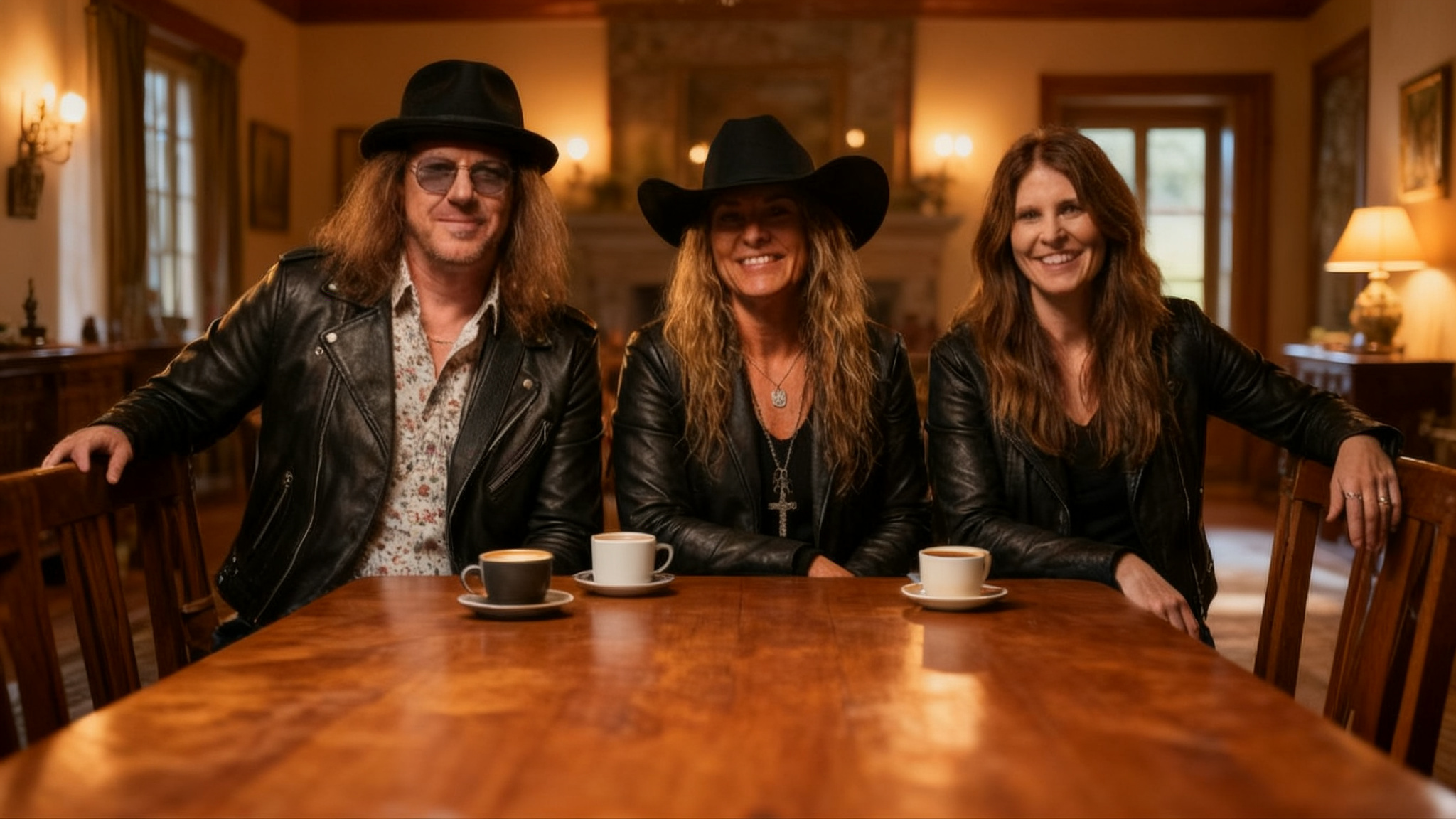
Hadleigh said yes. And Tessa's Lair became something bigger than any of them had imagined.
The Songs
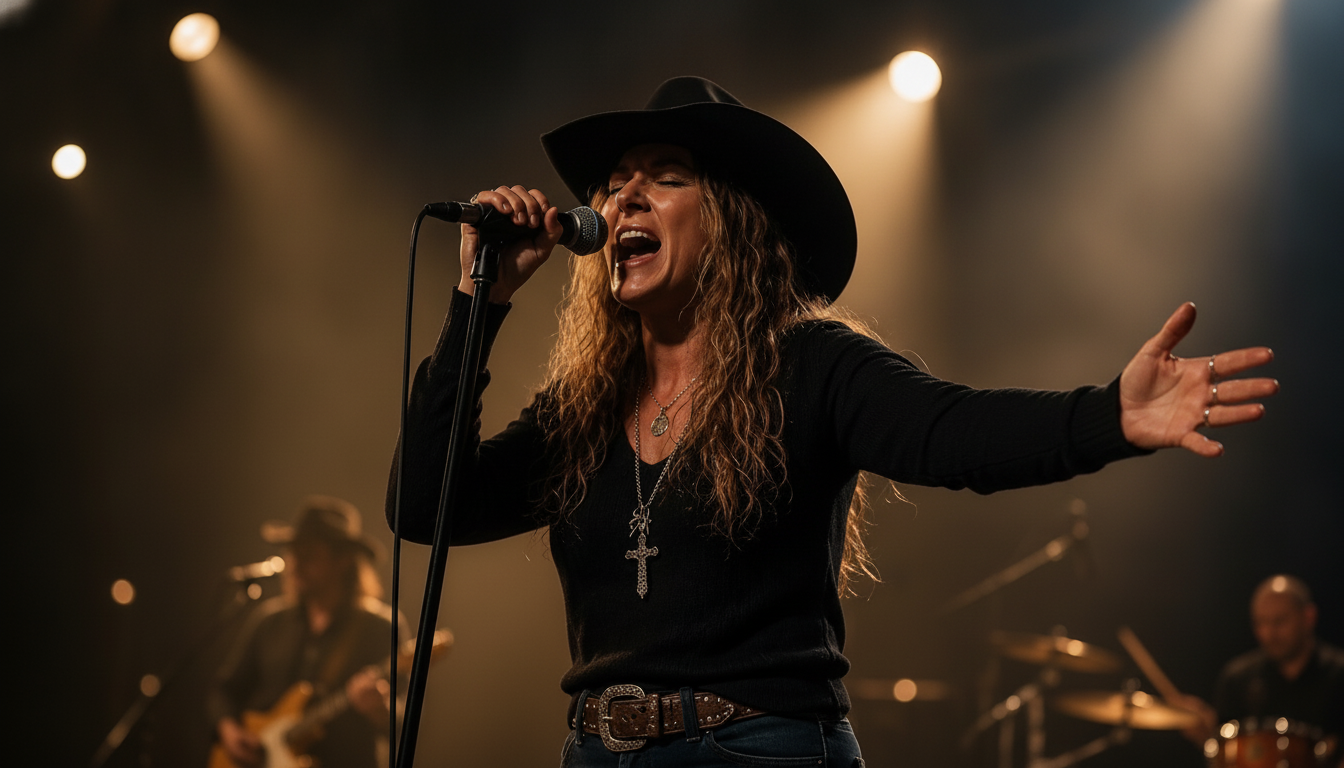
Hadleigh's voice carries some of the band's most powerful material, and for good reason — she's lived every word of it.
"Shattered Heartbeats" is her song. She wrote it about the helplessness of watching her husband drink himself to death under the crushing weight of depression after he lost their baby girl. It's a song about sitting next to someone you love and watching him slip away — not because he wants to leave, but because the grief is heavier than he is. It's one of the most harrowing songs in the Tessa's Lair catalog, and when Hadleigh sings it live, there's a silence that falls over the crowd that feels almost sacred.
"Seven Forever" is the other side of that grief — the pain she still carries from her daughter's death. It is brutally, mercilessly honest — a song that lays bare a mother's unrelenting anguish without reaching for silver linings or dressing up the wound. It builds to a moment that stops people cold: Hadleigh sustains a scream, raw and horrifying, torn from somewhere so deep inside her it sounds like a woman being pulled apart. The line is simple and devastating: "I am in hell, because you are in heaven." It shakes the listener to the core. Hadleigh doesn't perform that line — she survives it, night after night, and the fact that she does is its own kind of testimony.
"The Anchor and the Needle" — originally titled "19 Winters" — was written by Ken about his niece's tragic drug-related death. What makes the song so devastating is the angle Ken chose: he wrote it from the perspective of his sister and his mother — the two women left behind to carry a grief that never gets lighter. Ken watched them both manage their pain over the years, watched the way it shifted and settled and resurfaced and shifted again, and he put everything he witnessed into the lyrics. It is a song about the long, slow aftermath — the part of loss that comes after the funeral, when the world moves on and the family doesn't. Hadleigh's voice brings it to life. She sings it with the kind of weary, hard-earned understanding that only comes from a woman who has stared down loss and knows what it does to a family. When she hits the chorus, it's a testimony.
"Not Far Away" is the band's fan favorite, and it has one of the most remarkable origin stories in the Tessa's Lair catalog. As the bandmates grew closer as friends, they began sharing the deeper parts of their lives — the stories beneath the surface, the wounds that don't heal cleanly, the seasons where faith gets tested beyond anything you thought you could endure. Hadleigh opened up about what it had cost her to keep that shop running, to bury her husband and mourn her daughter and still show up every morning for eight families who needed her. And Tessa listened.
What Tessa heard moved her so deeply that she wrote the lyrics, took them to Ken, hummed the melody, and Ken laid down the music. They kept the project a secret from Hadleigh as they worked on it because they wanted to present it to her as a gift. The song is about those seasons when God seems the quietest — when you need Him the most and the silence is deafening. It's about the discovery that His silence is not His absence, and that the further away He feels, the closer He has been all along.
Tessa and Ken presented the finished song to Hadleigh, expecting she would take over the vocals if she liked it. And she liked it all right — she loved it. But she refused to take the vocals. She told them she couldn't. She said nobody could do to that beautiful song what Tessa did, and she insisted that Tessa stay the singer on it. It was a selfless call from a woman who could have claimed the spotlight and didn't, and it turned out to be a great decision. When Tessa sings "Not Far Away" live — with Hadleigh behind the kit, driving the groove, holding the rhythm down while the words pour out — it becomes something that audiences carry home with them and don't easily put down. Two women who know something about survival and faith, giving everything they have to a song that tells the truth about a God who is never as far away as He seems.

"Hidden Treasures" is Hadleigh's testimony set to music. It's based on Isaiah 43:3 — I will give you hidden treasures, riches stored in secret places, so that you may know that I am the LORD, the God of Israel, who calls you by your name. Hadleigh sings about the night she found that verse, the anxiety that had been crushing her, the fear that the fleet contracts wouldn't be renewed and the business would collapse. And she sings about what happened when she let go of the worry and trusted God — how business came pouring in from places she couldn't even imagine, how He was faithful when she couldn't see a way forward. It's a song about a God who calls you by your name and keeps His promises.
"Swimming in a Dream" is a different kind of wake-up call. It's about drifting through life, not thinking about salvation, risking an eternity of damnation — floating along in a dream state while the current pulls you toward the edge. The song was inspired by a woman Hadleigh knew, a friend whose life was circling the drain and heading toward destruction. The wake-up call came to her like a Damascus Road experience — without the violence and the blindness — a sudden, profound moment of clarity that broke through the fog and changed everything. That woman went on to become her church's worship leader and has had a successful career as a session musician. And as it happens, that connection is part of how Hadleigh and Tessa's worlds collided — music and faith intertwining, the way they so often do in the South, until the right people end up in the same room at the same time.
"If I Had Two Hearts" is a bittersweet anthem inspired by a tragic situation. It's about a friend of Hadleigh's who walked away from the right man and married the wrong one. As the years passed and her husband took her for granted, she realized, decades later, that she still loved her high school sweetheart and wished she had never taken the other path. Hadleigh sings it with a tenderness that guts you, capturing the ache of a heart that gave itself to the wrong person and can never quite get it back.
But it's not all melancholy. Not even close. Hadleigh's voice carries joy, strength, and a grounded warmth that comes from a woman who has been to the bottom and knows the way back up. Her performances are about testifying to what God has brought her through and standing in the light on the other side.
Off the Road
When she's not on tour with Tessa's Lair or keeping an eye on the shop, Hadleigh can be found at her country estate — a beautiful piece of property outside Hope where she keeps her three horses and where the pace of life slows to something approaching sane. She's a woman of deep faith, quiet strength, and a soft Southern accent that can make even the most technical discussion of diesel diagnostics sound like something out of a novel.
And she can cook. Lord, can she cook. Hadleigh Mae can stand toe to toe with the best of the Southern matriarchs — the women who raised families on cast iron and cornbread and never needed a recipe because the food lived in their hands. Her kitchen is legendary among the band and crew. After-show meals at Hadleigh's estate have become the stuff of Tessa's Lair folklore, and if you're ever lucky enough to be invited, you'll understand why.
She is, in every sense, the heartbeat of Tessa's Lair — on the drums, at the microphone, and in the way she carries herself. Hadleigh Mae is proof that you can lose almost everything and still build something worth keeping. That faithfulness matters. That grief and joy can live in the same heart and come out in the same voice. And that sometimes, the person holding everything together is the one you'd least expect — the one with the wrench in one hand, the drumstick in the other, and a song in her that the world needs to hear.